Planning GuideBy LDKPublished Updated 5 min read

Soccer Pitch Measurements: Sizes, Markings and Planning

Compare IFAB permitted pitch dimensions with FIFA stadium recommendation, learn how key markings are measured, and distinguish the playing field from the wider facility footprint.

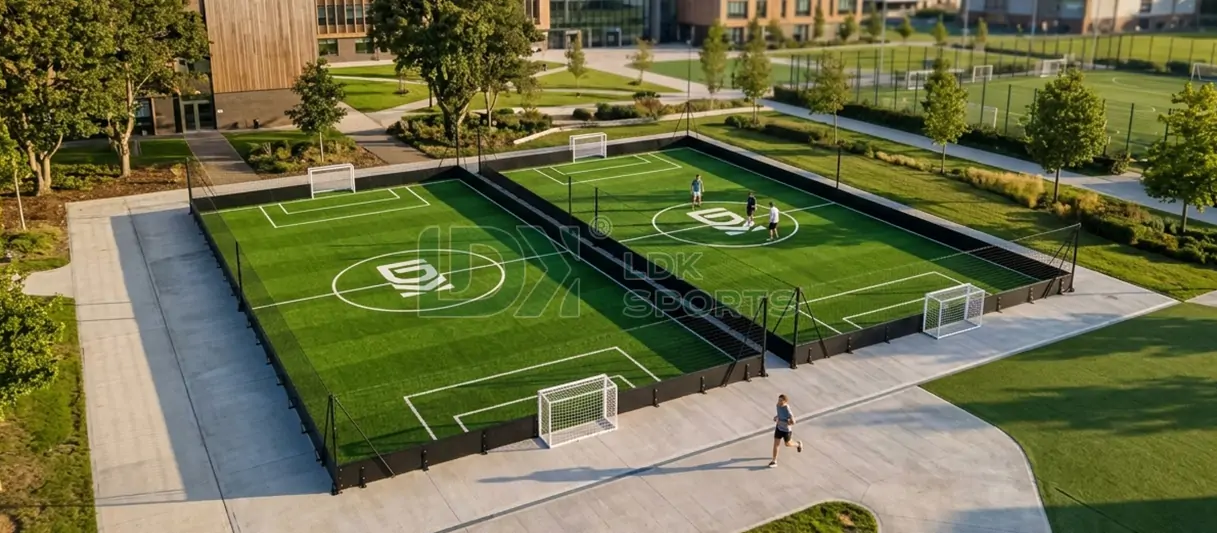
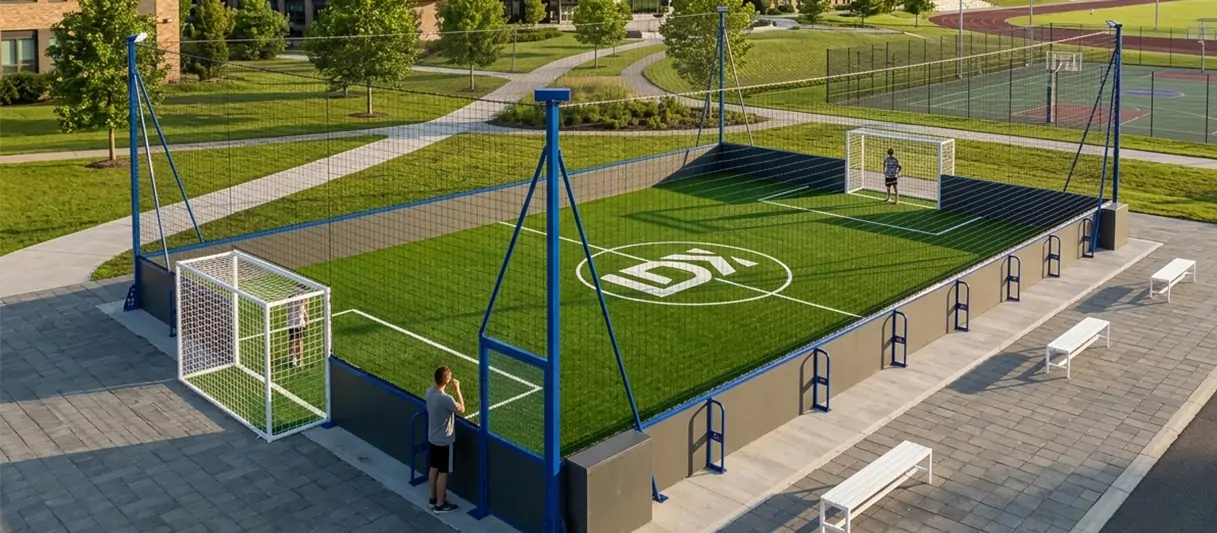
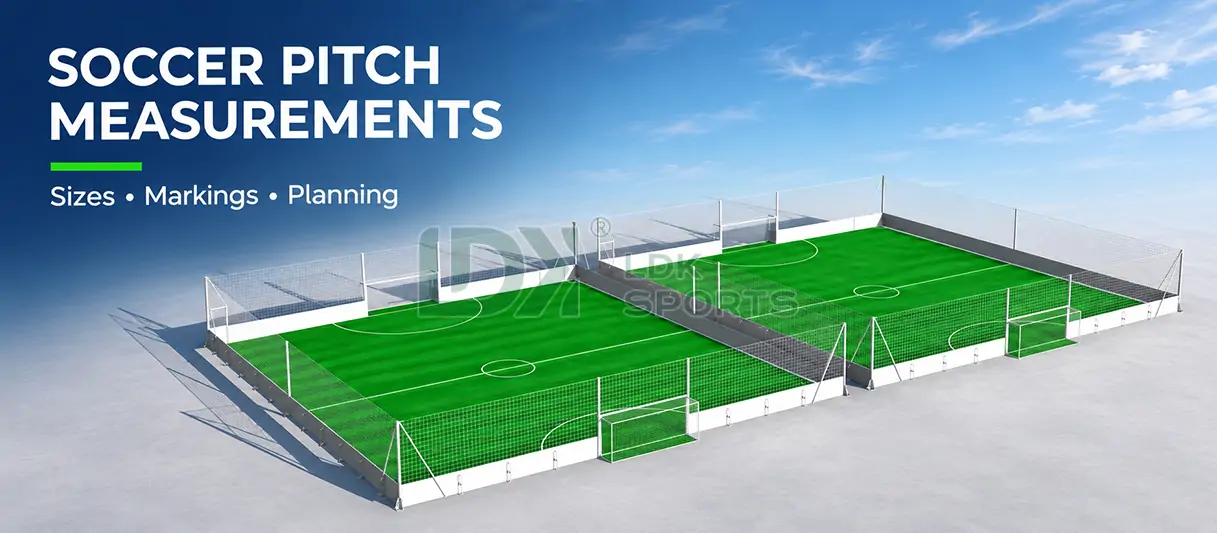
Several adjacent five-a-side soccer pitches with green artificial turf, white field markings, goals and perimeter netting under a blue sky.

Which pitch size fits your project?

Start with the intended use, not a default measurement:

  1. Identify the competition, age group and format the pitch must serve.
  2. Check that organisation’s current dimensions and marking requirements.
  3. Decide whether the stated size is the field of play or the whole site footprint.
  4. Map perimeter, access, drainage, lighting and spectator needs separately.
  5. Have the final dimensions and setting-out plan reviewed by the relevant governing body and qualified project team.

Soccer Pitch Measurements: Sizes, Markings and Planning Guidance

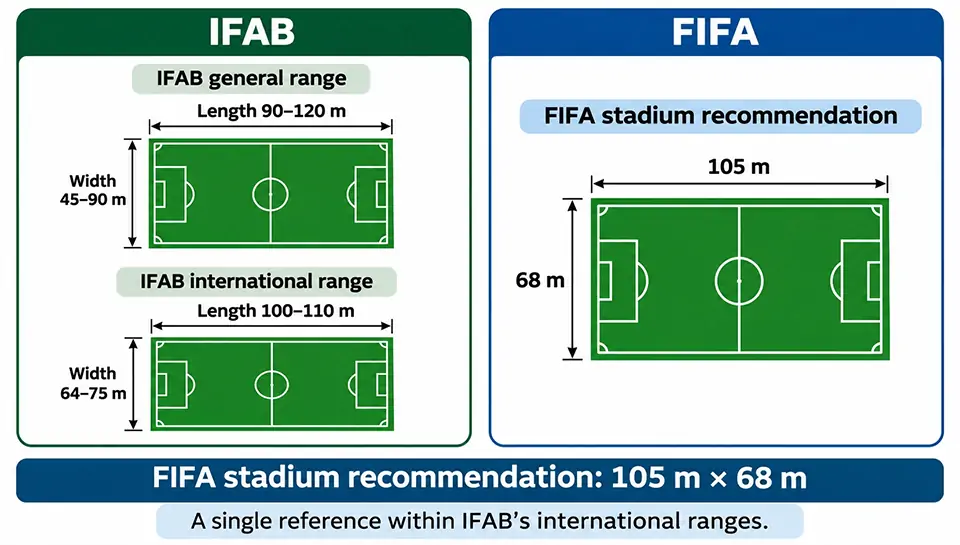
A soccer pitch does not have one universal adult size. Under IFAB Law 1, most matches may use a field 90–120 metres long and 45–90 metres wide; international matches have a narrower range of 100–110 metres by 64–75 metres. FIFA recommends 105 × 68 metres for the field of play in its stadium guidance. The right dimensions for a project depend on the competition, governing body and site plan.

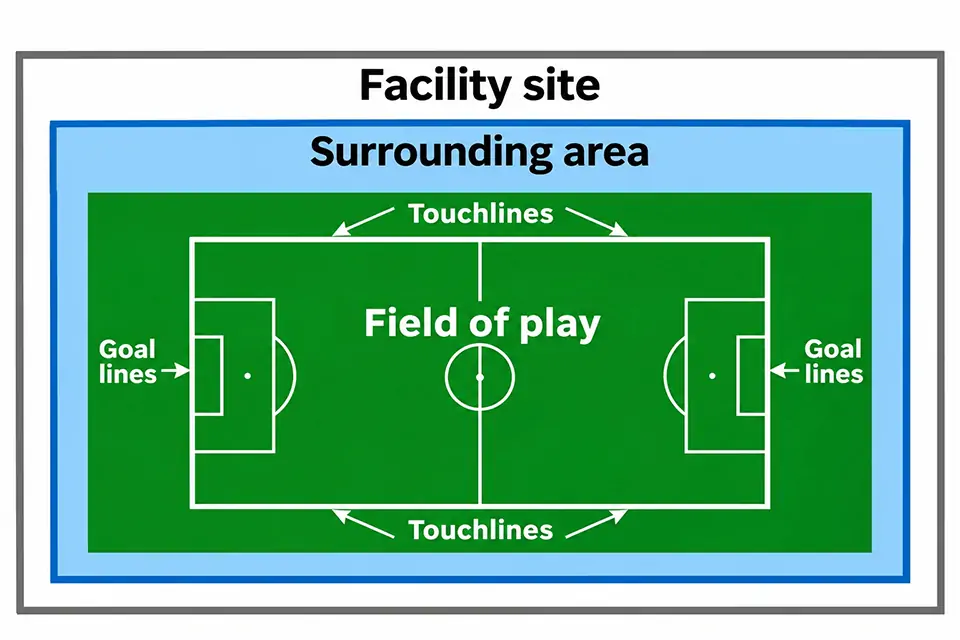
That distinction matters when comparing a regulation playing surface with the full space a facility needs. The field of play is the marked rectangle between the touchlines and goal lines. The surrounding pitch area may include additional turf and safety space beyond those boundaries.

What counts as a soccer pitch measurement?

The field is a rectangle. Its two longer boundaries are the touchlines; the shorter ends are the goal lines. IFAB treats the lines as part of the areas they enclose and says measurements are taken from the outside of the lines. The penalty mark uses a separate reference: measure from its centre to the back edge of the goal line.

For planning, write down which boundary your number describes. “105 × 68 m field of play” does not automatically mean the site, turf footprint or fenced area is also 105 × 68 m.

What dimensions does IFAB allow?

Match context Touchline (length) Goal line (width)
General matches 90–120 m 45–90 m
International matches 100–110 m 64–75 m

The touchline must be longer than the goal line. Competitions may select dimensions within the applicable range, so a club or facility should check the competition rules before fixing a design. These ranges are boundaries, not a recommendation that every possible combination is suitable for every level.

Why is 105 × 68 m often used as a reference?
Soccer Pitch Measurements: Sizes, Markings and Planning

FIFA’s Stadium Guidelines recommend a field of play measuring 105 metres by 68 metres. That figure is a useful reference for stadium planning, but it is not the only size permitted by IFAB Law 1. Keep the two statements separate: IFAB defines allowable ranges; FIFA recommends a particular stadium field size.

When comparing proposals, label the measurement source and scope. A plan that says “105 × 68 m” should make clear whether it means the marked playing rectangle or a larger paved, grassed or fenced footprint.

How are boundaries and key markings measured?

Use the official Law 1 reference points when setting out a field. Boundary dimensions are measured from the outside edges of the boundary lines. The centre circle has a 9.15 m radius. The goal area extends 5.5 m into the field from the goal line; the penalty area extends 16.5 m into the field. The penalty mark is 11 m from the midpoint between the goalposts.

The goal itself is centred on each goal line, with 7.32 m between the inside edges of its posts. All field lines must have the same width and may not exceed 12 cm; the goal line must match the width of the posts and crossbar. Confirm the current competition handbook and the applicable Law 1 edition before marking a project.

How much space is needed around the playing area?

The marked field is only one part of a facility layout. FIFA’s stadium guidance discusses the wider grassed area and the space between the field, advertising boards and spectator areas. The needed perimeter depends on the facility and competition; do not add a generic run-off figure to the playing dimensions without checking the relevant guidance and site constraints.
Soccer Pitch Measurements: Sizes, Markings and Planning
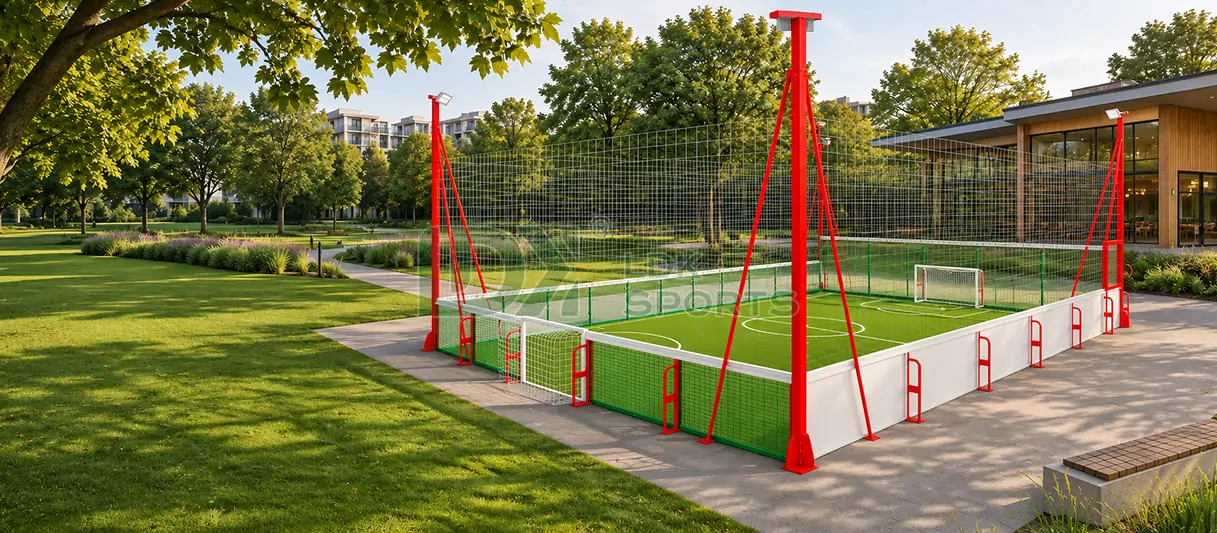
The playing rectangle sits inside the wider facility site.

Before approving a layout, list the playing rectangle, surrounding turf, access routes, team and officials’ areas, fencing or boards, drainage requirements and any local safety clearances as separate items. This helps prevent a field-size figure from being mistaken for a complete land requirement.

For a new synthetic-turf project, the playing surface and surrounding construction should be planned together. CAGEFOOT’s 3G pitch construction and synthetic turf page is the relevant internal destination for that next step; project-specific specifications should be confirmed with the design team.

FAQ

Is every full-size soccer pitch 105 × 68 m?

No. IFAB allows ranges, while FIFA recommends 105 × 68 m for stadium field-of-play dimensions.

What is the difference between an international pitch and FIFA’s recommended size?

IFAB gives international match ranges of 100–110 m by 64–75 m; FIFA’s stadium guidance recommends one size, 105 × 68 m, within those ranges.

Are pitch dimensions measured to the inside or outside of the lines?

IFAB says measurements are taken from the outside of the lines because the lines form part of the areas they bound.

Does the pitch size include the area around the field?

No. Field-of-play dimensions describe the marked rectangle. Surrounding grassed and facility areas are additional and need separate planning.

Conclusion

Choose pitch dimensions from the competition rules first, and keep the marked field separate from the surrounding facility footprint. IFAB ranges and FIFA’s 105 × 68 m stadium recommendation answer different planning questions.
Sources

View all articles
Cage football pitch for schools and communities with artificial turf, safety netting, and floodlightsPlanning Guide

A Cage Football Pitch Needs an Operating Plan Before It Needs a Build Date

Cage football pitch with impact-resistant lower panels, mesh enclosure and floodlights in a community parkManufacturing Insight

What Public Operators Should Consider Before Building a Cage Football Pitch

Outdoor cage football field with red steel posts, composite panels, professional artificial turf, LED lighting, and integrated mini soccer goals.Manufacturing Insight

Global Cage Football Supplier: ROI & Delivery Guide

Outdoor cage football pitch with artificial turf in an urban communityPlanning Guide

From Unused Corners to Football Pitches: How Enclosed Courts Are Finding New Sites

Empty cage football field in a landscaped community park with red steel posts, white perimeter panels and green artificial turf.Manufacturing Insight

Small Football Pitches Gain Ground as FIFA Expands Community Access

Modern outdoor cage football pitch with green artificial turf, metal mesh fencing, red support posts, and small goals.Planning Guide

Cage Football Facility Planning Shifts Toward Safer, More Durable and Smarter Outdoor Venues

Enclosed cage football court with green artificial turf, black netting, goals and floodlights at a modern sports facilityManufacturing Insight

LDK Introduces Flexible Cage Football Court Solutions for Modern Sports Facilities

Outdoor mini football pitch with artificial turf and an enclosed football cage for 3v3 games at a school and community park.Planning Guide

Compact Cage Football Pitches Put Lifecycle Planning at the Center of Public Sports Projects

Indoor composite board soccer cage with artificial turf, safety netting, red steel posts, and a small-sided football goal.Manufacturing Insight

France Indoor Sports Venue Introduces Composite Board Soccer Cage for Small-Sided Football

Portable wheeled aluminum soccer goal placed on a sunny football field.Planning Guide

LDK Presents Portable Aluminum Soccer Goal Solution for Outdoor Football Facilities

Indoor Cage Football Field for Community Youth Training.Planning Guide

Cage Football Fields Bring Flexible Play Space to Public Sports Projects

An indoor football cage features artificial grass, composite rebound boards, overhead netting and a white football goal.Planning Guide

Indoor Football Cage Solutions: Turn an Underused Building into a Football Venue

An LDK soccer field cage features green artificial turf, overhead netting and floodlights in a landscaped outdoor sports park.Planning Guide

Custom Soccer Field Cage Solutions

Five-a-side football cage with artificial turf, football goals and perimeter nettingSystem Guide

Football Cage Maintenance: A Simple Care Checklist

Artificial turf football field with perimeter fencing in a modern community sports parkPlanning Guide

Football Field Construction Mistakes & How to Avoid Them

Natural-looking artificial grass covers a football pitch with white field markings, a goal, and surrounding trees.Planning Guide

Artificial Grass: How Do You Choose the Right Sports Turf?

LDK cage football pitch with LED perimeter screens, overhead netting and a white goal in a landscaped outdoor sports park.Planning Guide

LED Advertising in Cage Football: Connecting Local Sport with Brand Visibility

Red-and-gray soccer cage with composite panels, flexible netting, goals, and video equipment in a landscaped urban sports park.System Guide

Smart AR Video Technology for Soccer Cages

cage football court with glass panels, composite boards, flexible netting and lighting.Planning Guide

Cage Football Courts Put More Focus on Flexible, Small-Sided Play

Removable Composite Plate football cage with red supports, white perimeter panels, upper netting and artificial turf.System Guide

Removable Composite Plate football cage: A Clear Maintenance Routine for Facility Teams

Outdoor 24 × 14 m soccer cage with gray composite boards, red support posts and upper ball-stop netting.Manufacturing Insight

2026 Market Insight: Mini-Pitch Growth Puts Football Enclosure Design in Focus

Dark green enclosed mini football cage with netting and a small goal displayed outside a sports equipment facility.Manufacturing Insight

Why Mini Football Cages Are Booming Worldwide

3D rendering of an outdoor soccer cage with green turf, perimeter boards, blue posts, overhead netting and goals.Planning Guide

Outdoor Soccer Cage: How to Plan the Right System for Your Site

LDK football cage rendering with green turf, blue supports, composite perimeter boards and overhead netting.Planning Guide

Football Cage Planning Guide: Sizes, Components and Project Quotes

Soccer cage project planning flow diagram.Planning Guide

Multifunctional Football Cage for Schools: Planning a Multi-Sport Court After the 2026 World Cup

Glass football cage on an outdoor pitch, with lower glass panels, a tall mesh enclosure, goals and a green playing surface.Planning Guide

Glass Football Cage: A Buyer Guide to Choosing an Outdoor System

Outdoor soccer cage with blue steel framework, glass panels, protective netting and artificial turf for football training facilitiesPlanning Guide

Futsal Cage Construction Guide

A freestanding red outdoor soccer cage with full ball-containment netting and artificial turf, used for small-sided football in a sunny open campus setting.Planning Guide

Outdoor Soccer Cages: Sizes, Costs and ROI for Facility Owners

Indoor soccer cage with green artificial turf and grey impact bumper boards.Planning Guide

Seasonal Maintenance Schedule for Outdoor Football Fields

View of no-infill artificial grass installed on a school football fieldSystem Guide

Free of filling Artificial Grass vs Natural Grass Football Fields

Landscaped outdoor football cage with rebound boards, mesh containment and lightingPlanning Guide

Planning a Small-Sided Football Facility: What to Confirm First

Rendered overview of an LDK removable composite-board soccer cage with counterweighted supportsSystem Guide

Understanding a Removable Soccer Cage

Industrial surface-treatment equipment inside a manufacturing workshopManufacturing Insight

From Manufacturing to Quality Control